Healthcare Professional Resources
Understanding Marine Food Health Benefits
Fish and shellfish gained recognition as optimal dietary choices due to their high-quality protein content combined with lower total fat levels. During periods when high-fat diets were linked to elevated risks of cardiovascular disease and certain malignancies, the National Research Council advocated for replacing fatty meats and full-fat dairy with marine proteins as a strategy to reduce fat and cholesterol consumption. Marine proteins provide excellent nutritional value with fewer calories, less total fat, and reduced saturated fat compared to terrestrial animal proteins. Additionally, they contain essential vitamins (including A, B-complex, and D) and minerals (selenium, iodine, iron, and zinc) associated with numerous health advantages.
Research demonstrates that regular consumption of fish and shellfish may reduce the incidence of cardiac events, cerebrovascular accidents, and elevated blood pressure.
Professional Recommendations
American health authorities suggest consuming 250 milligrams of EPA+DHA daily, recommending approximately 8 ounces of fish weekly, with emphasis on species rich in omega-3 fatty acids to achieve beneficial average daily intake. The American Heart Association advises 1000 milligrams of EPA/DHA per day for individuals with established coronary heart disease. Pregnant individuals and their offspring particularly benefit from omega-3s, and the 2010 Dietary Guidelines for Americans recommend a minimum of 8 ounces and up to 12 ounces of seafood weekly to obtain the health benefits of EPA and DHA. Species with moderate to high omega-3 content include oily ocean fish such as salmon, herring, mackerel, and sardines.
Food Safety Considerations Summary
Despite documented positive health outcomes from seafood consumption, several potential hazards exist within seafood products, including microbiological pathogens, naturally occurring marine toxins, environmental contaminants, and heavy metals. The primary health risks stem from pathogens and toxins, which can largely be managed through appropriate storage and handling practices. Recently, concerns have emerged regarding trace contaminants such as mercury and polychlorinated biphenyls (PCBs) detected in fish.
Risk-Benefit Assessment
Contemporary risk-benefit analyses conclusively demonstrate that the advantages of seafood consumption substantially exceed the risks. These investigations evaluate the overall health impact of eating seafood by considering low-level contaminants like mercury alongside the positive health benefits of nutrients including EPA and DHA.
Investigators at the Harvard Center for Risk Analysis examined various fish consumption scenarios, publishing their conclusions in multiple papers in the November 2005 edition of the American Journal of Preventative Medicine. Their findings indicated that reducing seafood intake would significantly decrease quality-adjusted life-years for the general population, even when accounting for toxic compounds such as methylmercury. In essence, the risks associated with avoiding fish consumption exceeded any risks from eating fish. To optimize health benefits through twice-weekly seafood consumption, American consumers need to more than double their current intake levels.
Optimizing Benefits While Minimizing Risks
- U.S. health organizations recommend daily EPA+DHA intake of 250 milligrams for general consumers and 1000 milligrams for individuals with cardiovascular disease. FAO/WHO experts recommend at least 200 milligrams of DHA daily for pregnant or nursing individuals, and 100-250 milligrams of EPA+DHA daily for children.
- Currently, only one in five Americans meets the recommendations established by the U.S. Food and Drug Administration, Dietary Guidelines Advisory Committee, and American Heart Association to consume fish twice weekly.
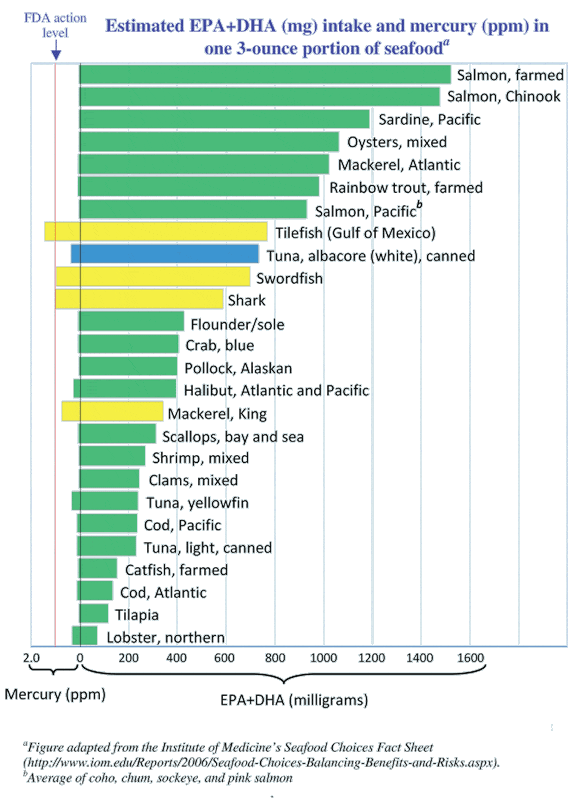
Risk-Benefit Visualization
The chart below summarizes the major benefits and risks associated with mercury levels in common seafood products. It displays the average EPA+DHA content and mercury concentration in a 3-ounce serving of seafood. All seafood highlighted in green falls well below the FDA action level of 1.0 part per million (ppm) for methylmercury (MeHg) in seafood, indicated by the red line on the chart. Albacore (white) tuna is highlighted in blue—it provides good EPA+DHA content but has moderate mercury levels. Sensitive populations (children 12 years and under, individuals who are or could become pregnant, and breastfeeding individuals) should limit albacore tuna to 6 ounces weekly. The four seafood species highlighted in yellow have higher mercury levels and should be avoided by these sensitive groups. Sensitive populations should consume a variety of seafood twice weekly to maximize health benefits while selecting options lower in mercury.
Information Resources for Healthcare Providers
Access the comprehensive reference guide designed to summarize current knowledge about nutritional benefits associated with seafood consumption, along with information on specific food safety concerns. This resource includes evidence-based guidelines for consumers to incorporate seafood into their diets in ways that provide nutritional advantages while minimizing potential risks.